Dedham School Committee Reviews Key Findings from Educational Model Redevelopment Report Focused on Grade and School Configurations
At its August 13 meeting, the Dedham School Committee reviewed the first of two reports from the Rennie Center for Education Research & Policy as part of Dedham Public Schools’ Educational Model Redevelopment process. The report presented last night focuses on grade configuration and school facilities options and offers recommendations for how Dedham can create stronger learning environments for students while making thoughtful, long-term investments in its schools.
The Educational Model Redevelopment has been a collaborative effort designed to align Dedham’s educational vision, instructional practices, and facilities planning around a shared goal: preparing students for lifelong success in a rapidly changing world. The Rennie Center has worked closely with Arrowstreet, the architectural firm supporting the Town of Dedham’s Facilities Master Planning process, so that educational priorities and future facility decisions can move forward together. Three of the scenarios presented will be further evaluated and considered in more detail through the Facilities Master Plan.
A Process Grounded in Data and Community Input
Over the course of the Educational Model Redevelopment project, the Rennie Center generated over 250 graphs on student enrollment, demographics, staffing, and performance data; examined 13 peer comparison districts; visited all seven Dedham schools; interviewed district and school leaders; observed learning in over 30 classrooms; and held 17 focus groups with staff, students, and families.
The process also provided multiple opportunities for broader community input, including five listening sessions, a community survey that yielded over 760 responses, a visioning event with ~100 votes per station and 80 open responses with additional feedback shared, and additional focus groups with key community organizations. Community members were asked what is working well today, where gaps exist, and what changes could better serve Dedham students in the future.
A List of Ten Possible Options For Consideration
Having developed a full slate of facilities scenarios, the Rennie Center and Arrowstreet narrowed the options to eliminate options that were not feasible given district data and enrollment trends, local and national educational models, priorities expressed by Dedham residents, available lands and considerations of feasible spatial, facilities-oriented, and space-planning concepts based upon MSBA guidelines.
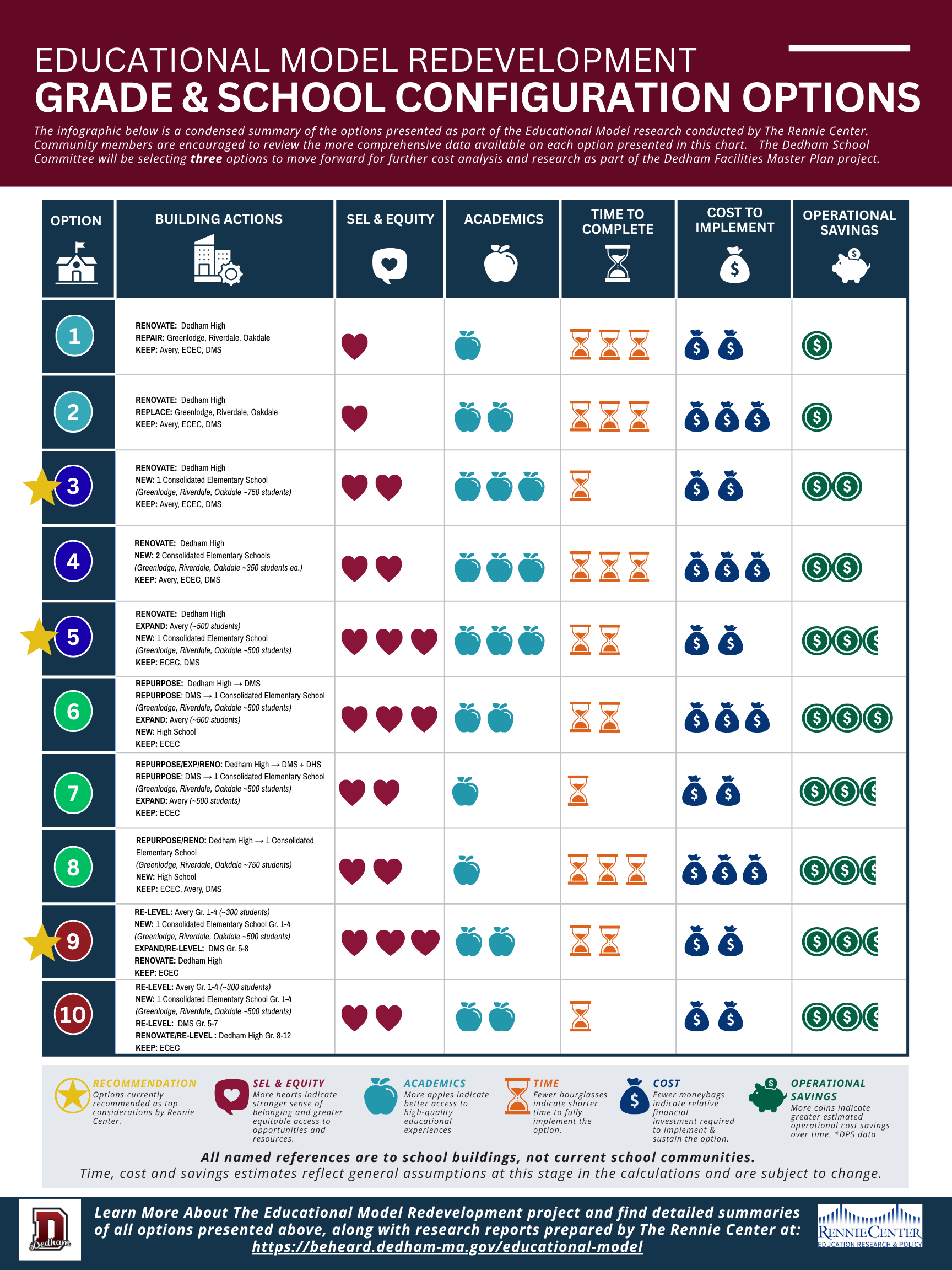
A final list of ten scenarios was presented as part of the report, based on four strategic approaches, and coded with a comparative rating scale that shows the the potential benefits and drawbacks each one offers to Dedham based on both educational and operational factors, including social emotional and equity impacts, academic impacts, time and cost. In developing these options, the report intended to answer questions such as how students should learn, how buildings should support teaching and learning, and what grade spans work best for Dedham students. As noted by Grace Wang who was presenting the report for the Rennie Center, “Every scenario has its pros and cons. Our goal is to maximize DPS students’ learning experiences while minimizing the time/cost for Dedham.”
At the conclusion of the report, the Rennie Center provided a recommendation of three scenarios from the ten presented, which based on their research would serve as the optimal choices for Dedham moving forward. Each of the three recommended options has its own benefits and drawbacks, but all would accomplish the purpose of moving elementary school students into higher-quality spaces more quickly, which emerged from the research as a clear priority expressed by the Dedham community. All three options also ranked in the middle tier for cost and none were higher than the middle tier for time, indicating that they could be accomplished for less money, and in a more efficient manner, than other potential plans.
Additionally, during the meeting, Dedham Public Schools Deputy Superintendent Dr. Ian Kelly, provided additional data for consideration on each option, sharing insight into how each scenario compared based on estimated future operational cost savings with regards to the annual school budget.
Next Steps & How Community Members Can Learn More
The School Committee will continue to review the findings, consider community perspectives, and work with district leadership and its partners as Dedham develops a long-term vision for its schools. The School Committee will vote on a final selection of three options from the ten presented in the report in mid to late September. Those three options will be shared with the Facilities Master Plan project for further analysis and consideration. The Facilities Master Plan process will be responsible for determining how to translate those decisions into a capital plan, including where new or renovated buildings would sit, how construction would be sequenced, what swing space might be required, and what should happen to other municipal or school properties. These items are not a part of this Grade Configuration and School Facilities report.
The School Committee recognizes that changes to school configuration and facilities will have a significant impact on students, families, staff, and the broader community. School Committee members will be working to share the Rennie Center’s report and findings with the Dedham community over the coming weeks, reaching out to community groups and neighborhoods to ensure that residents have a chance to examine the research, review the options presented and share feedback for the committee’s consideration prior to the vote.
-
Presentation and reports can be viewed at the Educational Model Redevelopment page under Project Materials & Resources
Learn more and speak with School Committee members at the Dedham Public Schools’ District Curriculum Night on September 10, 2026 at Dedham Middle School
The Educational Model Redevelopment is intended to ensure that future decisions about Dedham’s schools are grounded in what matters most: providing students with strong educational opportunities and learning environments that support their success.
The Grade Configuration and School Facilities report is the first of two reports connected to the Educational Model Redevelopment. A second report focused on teaching and learning is expected to be presented in September 2026.